Students hit a wall in Algebra 1 when radicals appear without clean answers. Estimating imperfect square roots worksheets for algebra intervention give them a structured way to build number sense before moving to complex equations. Instead of guessing or reaching for a calculator, learners practice placing values like √20 or √45 between whole numbers. This skill shows up repeatedly in simplifying radicals, solving quadratic equations, and graphing functions. Targeted practice pages keep the focus tight and measurable.
What does estimating imperfect square roots actually mean?
An imperfect square root is any radical that does not result in a whole number. √16 equals 4, but √18 falls somewhere between 4 and 5. Estimating means finding that range and narrowing it down to a reasonable decimal, usually to the nearest tenth. Worksheets built for algebra intervention break this into steps: identify the closest perfect squares, mark the position on a number line, and test a midpoint. The repetition builds fluency so students stop treating radicals like abstract symbols.
When should you use these worksheets in algebra intervention?
Pull these pages when students struggle with radical expressions, freeze during quadratic formula work, or rely entirely on device calculators. They fit well in small-group remediation, after-school tutoring, or as a warm-up before a unit on simplifying radicals. If your class needs extra support with perfect squares and radical approximations, you can start with structured practice that walks students through perfect squares and radicals step by step. The goal is steady progress, not speed.
How do students work through the problems without a calculator?
The process stays the same across most intervention sheets. First, list the perfect squares surrounding the target number. For √30, that means 25 and 36. Next, write the corresponding roots: 5 and 6. Place the value on a simple number line to visualize distance. Since 30 sits closer to 25 than 36, the estimate lands near 5.4 or 5.5. Students check by squaring their guess. If 5.5² equals 30.25, they adjust slightly downward. You can switch to pages that focus heavily on number line placement when spatial reasoning needs work. For groups that still depend on screens, try a set that removes calculator use entirely and forces manual approximation.
What mistakes show up most often on these pages?
Students usually trip in three spots. They pick the wrong bounding perfect squares, especially with numbers above 100. They assume the decimal part matches the distance linearly, which throws off estimates for values like √50. They also forget to verify by squaring their guess, so errors compound across a worksheet. Catch these early. Have learners write out the two nearest perfect squares every time. Require a quick multiplication check on the last line of each problem. Small habits prevent big gaps later.
How can you get the most out of each practice session?
Keep the sets short. Eight to ten problems per page is enough for focused intervention. Review the first two together, then let students work independently while you circulate. Ask them to explain their number line reasoning out loud. Verbalizing the steps reveals misunderstandings faster than grading alone. Print the sheets on clean, readable paper so numbers do not blur together. If you design your own versions, a clear typeface like Montserrat keeps digits distinct and reduces visual strain. Track progress with a simple log: date, problem set, average accuracy, and one noted error pattern. Adjust the next session based on that data.
Quick checklist for your next intervention block
- Prepare a reference list of perfect squares up to 225
- Print one short worksheet per student with space for number lines
- Model two estimates using the bounding squares method
- Require a squaring check on every answer
- Collect pages and mark the most frequent error type
- Plan the follow-up lesson around that specific gap
 Estimating Radicals Without a Calculator Worksheet
 Navigate Perfect Squares with a Scavenger Hunt
 Estimating Radicals with a Mental Math Strategy
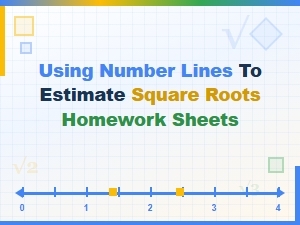 Estimating Square Roots with Homework Sheets Using Number Lines
 Practice Square Root Approximation Methods
 Practice Problems for Visual Estimating Square Roots