Students reach for calculators the moment they see a radical sign. That habit slows down algebra work and hides the number sense they actually need. A mental math strategy for estimating radicals classroom worksheet gives teachers a structured way to break that dependency. It trains students to anchor unfamiliar roots to nearby perfect squares, make quick approximations, and check their own work before moving on.
What does a mental math strategy for estimating radicals actually look like?
The approach is straightforward. Students identify the two perfect squares that surround the radicand, place the root on a number line, and refine the estimate using simple fraction or decimal reasoning. The worksheet format keeps the steps visible, provides spaced practice, and leaves room for students to write their thinking instead of just circling answers. If you need a clean starting point, the classroom worksheet layout walks students through the anchor-point method with guided examples and independent problems.
When should you hand out this type of worksheet?
Use it right after students memorize perfect squares up to 225 and before they tackle quadratic equations or the Pythagorean theorem. It works well for warm-ups, small-group intervention, or homework that replaces calculator drills. Teachers running algebra support blocks often pair it with targeted practice for imperfect roots to close gaps before unit exams or standardized testing windows.
How do students estimate square roots without a calculator?
Take √40 as an example. First, find the bounding perfect squares: 36 and 49. That means √40 sits between 6 and 7. Next, check the distance. 40 is 4 units above 36 and 9 units below 49, so it is closer to 6. A quick linear estimate puts it around 6.3 or 6.4. Students write the bounds, mark a simple number line, and record the decimal guess. The goal is not exact precision. The goal is a reasonable estimate that survives a quick sanity check. For more problems that follow this exact sequence, you can pull exercises from a practice set focused on perfect square anchors.
Where do students usually get stuck?
Most errors come from skipping the bounding step. Students guess randomly or try to divide the radicand by two. Others mix up squaring and square rooting, writing √50 ≈ 25 instead of checking 7² and 8². A few rush the decimal placement and claim √20 ≈ 4.8 without noticing that 4.8² is already over 23. The worksheet prevents these slips by forcing students to write the lower bound, upper bound, and distance ratio before they commit to a decimal.
How can you run a quick practice session that sticks?
Keep the problems short and the feedback immediate. Give students six radicals per page. Have them circle the two perfect squares first, then draw a tick mark on a blank number line, then write the estimate. Walk the room and check the bounds before they calculate decimals. Pair students up to compare answers and explain why one estimate is tighter than another. If you want the pages to look clean and readable, pick a straightforward typeface like Montserrat for the headings and problem sets.
What should you check before the next lesson?
Run through this short list to make sure the strategy actually transfers:
- Students can list perfect squares from 1 to 225 without hesitation
- Every estimate includes written lower and upper bounds
- Number line sketches show proportional spacing, not random ticks
- Decimal guesses stay within 0.2 of the actual root for radicands under 100
- Students catch their own errors by squaring the estimate mentally
Print one double-sided sheet, set a ten-minute timer, and collect the work before anyone reaches for a device. Review the bounding steps first, then adjust the next set of problems based on where the estimates drift. Repeat twice a week until the mental routine feels automatic.
Learn More Estimating Radicals Without a Calculator Worksheet
 Estimating Imperfect Square Roots for Algebra Intervention
 Navigate Perfect Squares with a Scavenger Hunt
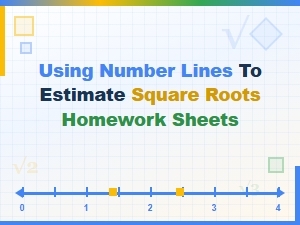 Estimating Square Roots with Homework Sheets Using Number Lines
 Practice Square Root Approximation Methods
 Practice Problems for Visual Estimating Square Roots