High school students often freeze when they see a radical that is not a perfect square. An estimating square roots scavenger hunt activity for high school turns that hesitation into movement and repeated practice. Instead of staring at a static worksheet, students walk around the room, approximate a radical, find the matching answer card, and move to the next problem. The format keeps the pace steady, reduces off-task behavior, and gives you a clear view of who understands number line placement and who needs a quick reteach.
What exactly is an estimating square roots scavenger hunt?
It is a self-checking circuit where each card holds a radical expression at the top and the answer to a different card at the bottom. Students start at any station, estimate the value to the nearest tenth or whole number, locate that answer on another card, and continue until they return to their starting point. The activity focuses on approximating non-perfect squares, comparing radicals, and placing values between consecutive integers. You can print the cards on standard paper, tape them to walls or desks, and hand out a simple recording sheet.
When should you run this activity in your math block?
Use it right after you introduce perfect squares and basic radical notation. It works well as a day-two practice session, a pre-quiz review, or a station rotation when you need to pull a small group for targeted support. If your class struggles with placing values like √20 or √45 on a number line, this format gives them repeated, low-stakes reps. You can also pair it with number line homework sheets when students need extra visual support before moving to independent work.
How do you set up the stations without losing class time?
Print twelve to sixteen cards and scatter them around the room in a random order. Each card should show one problem at the top and one answer at the bottom. The answer on any card must match the problem on a different card, creating a closed loop. Give each student or pair a recording sheet with numbered boxes that match the card IDs. Set a visible timer, explain the loop rule, and let them start at any station. If you want to reduce copying, ask students to write the card ID next to their estimate instead of rewriting the full radical.
For quick prep, type the problems in a clean, readable font like Lato so the radical symbols and decimal answers stay sharp when printed. Laminate the cards or slip them into page protectors if you plan to reuse them next semester.
Which mistakes usually trip up high school students?
Students often guess instead of bounding the radical between two perfect squares. They might say √30 is about 6 because 30 looks closer to 36, skipping the step of checking 25 first. Others round too early or mix up the answer loop, which breaks the circuit and causes frustration. A few will try to calculate exact decimals in their heads, which slows the pace and defeats the purpose of approximation.
You can prevent most of these errors by modeling one full cycle on the board. Show how to identify the lower and upper perfect squares, pick a reasonable tenth, and verify the answer matches another card. If mental calculation is the bottleneck, a short drill using a mental math strategy for estimating radicals can build confidence before the hunt begins.
What small adjustments keep the activity running smoothly?
Keep the radicals within a predictable range at first. Start with numbers between 1 and 100, then add values up to 200 once students show consistent bounding skills. Place cards at different heights and in low-traffic zones to avoid bottlenecks. Give pairs one clipboard and one pencil so they have to talk through each estimate instead of splitting up and working silently.
Build in a self-check mechanism. The loop structure already does this, but you can add a quick answer key posted near your desk for groups that finish early. If a pair gets stuck, ask them to retrace their last two steps and check whether they matched the problem to the answer or the answer to the problem. Swapping those two is the most common circuit break.
When you are ready to run the full version, you can grab a complete ready-to-print scavenger hunt set that includes pre-made cards, a recording sheet, and an answer loop map. Having the materials aligned saves setup time and keeps the focus on student reasoning.
Ready to try it tomorrow?
Use this quick checklist before the bell rings:
- Print 12 to 16 cards and verify the answer loop closes correctly
- Tape cards in random order away from doorways and sharp corners
- Prepare recording sheets with clear card ID boxes
- Model one bounding example on the board using perfect squares
- Set a 15 to 20 minute timer and circulate to catch rounding errors early
- Keep a short answer key nearby for fast finishers
Start with a small set, watch how students place their estimates, and adjust the difficulty next time. The movement and self-checking loop do most of the heavy lifting, so you can spend your time listening to student reasoning and fixing small misconceptions before they stick.
Explore Design Estimating Radicals Without a Calculator Worksheet
 Estimating Imperfect Square Roots for Algebra Intervention
 Estimating Radicals with a Mental Math Strategy
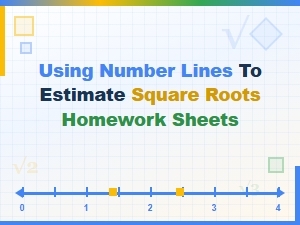 Estimating Square Roots with Homework Sheets Using Number Lines
 Practice Square Root Approximation Methods
 Practice Problems for Visual Estimating Square Roots