Students often reach for a calculator the moment they see a radical sign, but learning to estimate square roots by hand builds number sense that carries through algebra and geometry. A perfect squares radicals estimating worksheet without calculator gives learners a structured way to practice placing irrational numbers between whole numbers, comparing values, and checking their own work. This skill shows up on classroom quizzes, standardized tests, and anytime a quick approximation is needed during problem solving.
What Does Estimating Radicals Without a Calculator Actually Mean?
Estimating a radical means finding the two consecutive whole numbers that surround it. You start by referencing a list of perfect squares like 1, 4, 9, 16, 25, 36, 49, 64, 81, and 100. When you see √45, you recognize it falls between √36 and √49, which means the answer sits between 6 and 7. The worksheet format simply repeats this process with different radicands, gradually increasing difficulty so students build confidence instead of guessing randomly.
When Do Students Need This Skill?
Teachers assign these practice pages right before introducing the Pythagorean theorem, simplifying radicals, or solving quadratic equations. Students also use estimation when checking calculator answers for reasonableness, plotting irrational numbers on a number line, or comparing radical expressions during algebra intervention blocks. If a learner can quickly say √72 is closer to 8 than 9, they will move through higher-level math with fewer calculation errors and less frustration.
How to Build a Worksheet That Actually Works
A strong practice sheet starts with a clear reference table of perfect squares up to 225. Follow that with three sections: basic placement between integers, closer-to-which-integer questions, and number line plotting. Keep the layout clean so students can write their thinking steps without running out of room. If you design your own pages, pick a readable typeface like Montserrat to keep fractions and radical symbols sharp on printed paper.
Step-by-Step Example for Estimating √45
Find the perfect squares around 45. You will see 36 and 49. Write down their roots: 6 and 7. Since 45 is closer to 49, the estimate leans toward 7. A reasonable decimal guess is 6.7. Check by squaring 6.7, which gives 44.89. That confirms the estimate sits in the right spot. Repeat this pattern across ten to fifteen problems, and the mental process becomes automatic.
Common Mistakes Students Make (And How to Fix Them)
Many learners pick the wrong bounding squares because they skip writing the perfect square list first. Others assume the decimal part matches the distance linearly, which throws off estimates for numbers like √50. Some students also forget that √18 is between 4 and 5, not 3 and 4, because they misread the table. Fix these errors by requiring a quick reference chart on every page, asking students to circle the two closest perfect squares before guessing, and adding a self-check column where they square their estimate to see if it lands near the original radicand.
Where to Find Ready-Made Practice Pages
If you prefer not to build problems from scratch, you can grab a printable set that walks students through integer bounds and decimal approximations. For learners who need extra support, targeted intervention sheets break down uneven radicands into smaller steps. When you want to move practice off the desk, a classroom scavenger hunt turns estimation drills into a movement-based review.
Quick Checklist Before You Print or Assign
- Verify that each problem includes blank space for students to write the two surrounding perfect squares
- Make sure the worksheet progresses from whole-number bounds to simple decimal estimates
- Add an answer key that shows the squaring check, not just the final number
- Keep the font size at 12pt or larger so radical symbols do not blur when photocopied
- Test one page yourself without a calculator to catch confusing layouts or missing reference tables
Hand out the first three problems as guided practice, walk through the bounding-square method together, then let students finish the remaining items independently. Collect the sheets, check the self-check columns, and reteach only the steps where estimates consistently miss the mark.
Try It Free Estimating Imperfect Square Roots for Algebra Intervention
 Navigate Perfect Squares with a Scavenger Hunt
 Estimating Radicals with a Mental Math Strategy
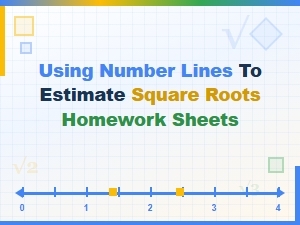 Estimating Square Roots with Homework Sheets Using Number Lines
 Practice Square Root Approximation Methods
 Practice Problems for Visual Estimating Square Roots